I opted for a Log Home. I teleported to my little lot of land but not before landing innumerable times on a complete strangers porch. Eventually I located my new Log Home at the end of a track in a leafy suburban area. It looks like the land behind my house is earmarked for future development, but for now, it is a large green field with hills on the horizon.
Next, I changed the color of both the exterior and interior walls of my new home, and I was delighted by being able to select a worn-out peeling white paint for the woodwork. While playing with my windows (they open and shut smoothly) I was distressed to see my neighbor’s swimming pool. It is enormous, there is no landscaping, and it seems very “out of place!”
This discovery lead to visiting various garden centers looking for large leafy plants (trees). I was soon able to plant a screen to soften the lines of the concrete rectangle next door.
However, to cut a long retail story short, I ended up purchasing a greenhouse.
I prefer the greenhouse to my Log Home and may move in soon.
“Jesus is Lord Garage & Salvage” located in the Village & BarDeco (Second Life)
Presidential candidates might find a quick pit stop and meditation at the “Jesus is Lord Garage & Salvage” auto repair shop* a helpful activity. A chance to receive the combined gifts of a practical yet spiritual car mechanic.
Given the troubled state of American politics, all opportunities to find life supporting last straws are surely going to be helpful? I have a useful suggestion of my own called bonsai politics. This is based upon Mitch McConnell’s advice that President Obama should not be allowed to nominate a candidate for the Supreme Court during his remaining time in office.
This suggestion could be adopted in other areas for example:
Last year of mortgage payments no longer to be paid because it is the last year.
Last year of a prison sentence need not be served.
Last year of school to be dropped.
etc.
You get the idea. For the moment let us concentrate on the reduction of political terms that will lead to bonsai politics. That is we sever the agreed upon time limit for Presidents to make decisions. This frees us to wonder why the elected fellow should stay in office if not expected to carry out duties anymore? The result of this tinkering results in a new shorter (also agreed upon) time period. We can now once again apply Mitch McConnell logic to this new block of abbreviated time. After all, what is there to stop us from continuing to cut back time whenever we don’t agree on something? It’s a lovely idea because we can reverse engineer decisions until we eventually enter negative time, that is the time that has already been ‘used up’ and passed by. Now I suggest we can keep going backward until we get the opportunity to re-select George Washington “the only president to receive the totality of electoral votes“. (Wikipedia).
Toolbox by NiR McBride
Personally, I believe if we run George posthumously he would win again. (My logic is suspect but perhaps a shade more realistic and comforting than Donald Trump’s logic?) So, I propose we all stop at the “Jesus is Lord Garage & Salvage” repair shop to revive George Washington. Consider this as you sit cross-legged amongst the monkey wrenches and incense of the inspection pit: George Washington was neutral, a public servant working for America. He did not belong to a party. Robert Alexander writing at the time of the government shutdown of 2013 talks about George Washington’s farewell speech in which the retiring president of America “.. cautioned against the vengeful practices of political parties. To him, parties put their own interests above those of the country.” The thing is, I am not sure that George pictured vengeful practices within the political parties themselves? Watching recent events makes me wonder if a Guardian Ad Litem might be found at “Jesus is Lord Garage & Salvage” to represent the best interests of bewildered voters?
Tealights by Kean Kelley – The Village & BarDeco Church
*Repair shop located in the virtual world of Second Life. “Jesus is Lord Garage & Salvage” can be found at The Village & BarDeco owned and designed by Dandy Warhol (terry.fotherington).
Yesterday I added a post to Cyberloom, and I realized that it is three years since the last post was added to this blog! All I can say is time flies when you are preoccupied! Today, I have been reviewing some of my 190+ earlier posts. The reason for this review is that my friend Suzanne asked me to send her the link to this blog. Gosh, I thought how to guide someone through a blog about a peculiar hobby visiting the Metaverse? Well, Suzanne, I hope that this post will help.
I began writing this blog in 2008 when I was an Adult Education student looking into online education for my Certificate in Advanced Studies. One of the first things that hooked me into the virtual world was the discovery that I could interact with it. In an early post, I wrote about this in a piece titled: Living in a Painting: Introducing Second Life and Windlight. I had discovered I could take photographs and adjust the lighting in a virtual 3D space reached by my computer. Strange that this machine of glass and metal and tiny computer chips could open up such a vast and visually imaginative realm.
Majilis al Jinn. Sands of Time by Calein Flux
I have a few preoccupations when traveling in the virtual world. The first is an ongoing interest in adult learning in its various manifestations:
Another recurring theme concerns a stack of sketchy questions about who we are as we connect with each other across the room, across virtual space and multiple time differences? Here are some of these posts:
Virtual Art is another area that fascinates and my approach to the work of Metaverse Artists stems from when I was a photographer working in London, and I would help artists by photographing their work for publicity purposes. I soon found that Second Life was teeming with incredibly thoughtful and talented artists. I also saw that there was a problem in that if you did not enter the 3D online space via your computer, you could not see and experience the work of these artists. This lead me on a mission to record the work of virtual world artists, here are just a few: Archetypal Robots and Giant Donuts
I have signed up for this summer’s Games Based Learning MOOC which is examining the use of ‘gamification’ in educational settings. I have been thinking about running a class that looks at online gaming for ‘older gamers’ as well as the many wild and wonderful claims that are being made about the benefits of ‘brain fitness games’.
To launch this post here is a short definition of Gamification as supplied by Wikipedia:
“Gamification is the use of game thinking and game mechanics in a non-game context in order to engage users and solve problems. Gamification is used in applications and processes to improve user engagement, return on Investment, data quality, timeliness, and learning. The word was coined by Nick Pelling.”
Background
I taught Second Life for several years to small groups of 6 people at a time. these classes ran in sessions of 2 hours a week for 8 weeks. Student’s ages ranged from 50 to 90+ and the average age was around 72.
The classes were enormous fun to teach and sometimes quite challenging. I touched upon what I perceived were the positive implications of playing Second Life for brain health back in a 2010 blog post titled: Second Life – Why Would You Go There? #8 – To be a dancing banana. The classes were arranged with everyone sitting at a PC in the computer lab snd my instructor PC screen was projected in front of the class. This often caused an initial ‘perception-in-a-swirl’ moment for people, a visual shock that required conscious deconstruction and (if all went well!) perhaps even a speeded up ‘learning moment’. This was because many in the class were more used to TVs and their single viewing vantage point on screen. In class students saw each others monitors revealing various angles of the same scene generated by each avatar’s own camera view.
Two avatars (students of Second Life) sitting on the roof tops drinking herb tea
So the students sat side by side in a room full of monitors which in turn simultaneously portrayed each student as represented by their avatars in a parallel virtual world. They collaborated with each other and shared many funny moments together. Students had to accept that everything was somewhat unpredictable and out of control. Technical glitches and quirks would cause us to suddenly have to adapt our declared plans for the day and see us switching destinations and activities in-world at the last minute. Despite the technological balancing act students appeared to enjoy and feel safe exploring the virtual world together. They helped each other to problem solve and remember repetitive actions (important for older gamers) while I assisted anyone who was more challenged by the activities in hand. Beyond providing basic technical training and assistance; I saw myself as their guide in a foreign land, helping them avoid the tasteless and rather daft and dubious ‘adult’ areas whilst seeking out educational, beautiful and fun locations.
It was a ‘happening!’ Over time I began to see the class had more in common with a ‘happening‘ than anything more traditionally educational. Students tended not to go ‘in-world’ from home. I did set up two times a week when I was available to meet them online but only a small number of students ever found their way into Second Life by themselves. The majority clearly enjoyed the classes with the group and guide and did not see themselves going off and exploring alone.
Those few who managed the computer set-up, online connection, application download and virtual world login did become independent virtual world citizens in their own right. Unfortunately, Linden Labs proceeded to make a number of peculiar business decisions that ultimately deterred most of these adventurers from using Second Life. In particular the SL viewer went through a wide range of updates and changes (ironically aimed at making the application more user friendly…) that meant people had to keep relearning the dashboard and menus. Perhaps if Second Life had kept support up for the older standard viewer with upgrade and downgrade options they would have sustained interest? Google allows this upgrade/downgrade option for its products and keeps this option for some time before fully switching to its new (thoroughly tested) dashboards. An approach like this would have dramatically helped my students (and no doubt other Second Life users?)
Watching TV in the virtual world. Golden Oriole freebie TV created by Oriolus Oliva
What next? Eventually, Linden Labs cut their subsidy for educational institutions and educators packed up their inventories to migrate to new smaller worlds. There are now so many virtual worlds available in the educational virtual world universe that it is comparable to making a choice on what to watch and where to go on American cable TV. This seems to be an exciting, yet somewhat unstable period for virtual worlds and education. Technological stability is a necessity for educational settings and often the best applications require powerful up-to-date computers. As I look at options for the those who have leveled 50+ years in the area of fun, educational and challenging games it is important to stay in touch with the fact that many are using computers that are more than 3 years old.
Working on Kunst Himmel’s iMak 3.0 computer getting ready to launch WOW
This is just a quick summary of my experience of working with Second Life and older gamers, this is my stepping off point into new learning. This brings me to one of the aspects that intrigued me about this summer’s Game Based Learning MOOC and that is that it appears to be particularly geared towards World of Warcraft (WoW). This seems to be a highly structured virtual gaming world. However, I cannot judge this virtual world / game without finding out more about it first. Inevitably exploration in WoW will cause comparisons to be made with Second Life and before seriously contemplating introducing this game to a class of older learners/gamers I need to play it myself. So wish me luck!
InWorldz SXSW Event: Rainer Maria Rilke tree by Teal Freenote. (Not the real name of this sculpture but it was a tree covered with Rilke quotes!)
InWorldz put in an appearance at SXSW the music, film and interactive conference held in Austin, Texas every year. The virtual world categorized itself as a game developer at the convention and simultaneously showcased itself within InWorldz. In effect, they connected the conventional with the virtual with their “Welcome to Our World” exhibit.
InWorldz SXSW Event: English galleon at dusk created by Nyx Breen
For this post I collected together some photos I took on the Arts & Literature sim. There are other sims, each devoted to displaying different topic areas. These areas include: Education, Entertainment, Technology, Physics, Fantasy & Roleplay, Transportation plus Harbor – Boating & Nature. There is much to see and explore as InWorldz very cleverly invited their most talented citizens to show off recent or favorite works. This is certainly a very good idea for it means the pieces on display have a depth and maturity that can only be the product of hours of thoughtful work and personal skill development. It is also worth pointing out that many of these artists cut their baby avatar teeth in Second Life before being drawn into InWorldz with its generously sized building spaces and atmosphere of calm. The other observation worth sharing is that in practice many artist avatars have bi-world passports. That is, they work in Second Life and in InWorldz as interstellar traveling artists and troubadours. (Some probably travel even further into the OpenSim firmament appearing in multiple worlds.)
InWorldz SXSW Event: Dreaming Side Table (detail from larger exhibit) by Sy Celina
Above you can see a detail from Sy Celina’s ‘Dreaming’ exhibit which was originally built as a Christmas display. The exhibit, a comfortable living room and child’s bedroom is housed inside a giant blue Christmas ornament. The room conjures up an atmosphere of childish excitement with idealized Christmas memories and presents stacked high by the perfect roaring log fire, yet the furniture in the room is strangely transparent. I opted to avoid taking a ‘Christmassy’ picture as I found myself drawn to the pipe holder and photographs perhaps the two most solid and ‘real’ memory items in the strange room?
InWorldz SXSW Event: Steampunk Tree by soror Nishi
soror Nishi is one of my favorite artists. Her work is always full of color and humor. Her exhibit ‘The Steampunk Tree – a mechanical marvel’ (above) was in 3 sections, with the tree itself linked by a series of pipes to two other peculiar machines. She had placed 5 goats on a high platform at a feeding trough where they seemed to be eating colorful gourdes at one end whilst regularly emitting spherical droppings at the other. These droppings were then carried along a watery chanel to a filtering chamber filled with giant amoeba/octopus type creatures before being sent into the steampunk tree and thereby feeding its ability to deliver flourescent spores into the air. Smelly virtual worlds have yet to be invented but I am positive that soror Nishi’s tree smells like new roses growing in a farmyard.
inWorldz SXSW Event: Alizain Goldflake’s tribute to Kay Ryan’s poem ‘The Niagara River’
Finally, I have featured Alizarin Goldflake’s display, an unusual black and white exhibit based upon Kay Ryan’s poem ‘The Niagara River’. This exhibit makes full use of the three dimensions available with virtual spaces and also employs sound effects. As you wander around the exhibit the black and white photographs of trees are constantly scrolling slowly around the walls, at your feet water is steadily running over your toes and in the background you can hear the sounds of a river and distant human voices. Alizarin wrote about this installation in her blog post ‘The Niagara River’
Because the poem uses a dining room melded with a river as a metaphor for the passage of time, life, or maybe the constant stream of consciouness, my installation has a sound environment that mixes the sound of rushing water with steady stream of people talking. The people have long departed from the room, from life, but their voices linger like ghosts and their names float in hover text.
The ‘Welcome to Our World’ exhibit is still open in InWorldz. The best way to visit is to go to InWorldz.com and register before simply downloading their viewer. A display board at the landing area will provide a teleport straight over to the exhibition sims. They always have helpers at the landing area who can direct you as you take your first steps in Inworldz. For more photographs of the InWorldz SXSW exhibits visit Rig’s Photos and scroll down through his posts (he has 5 InWorldz photo posts).
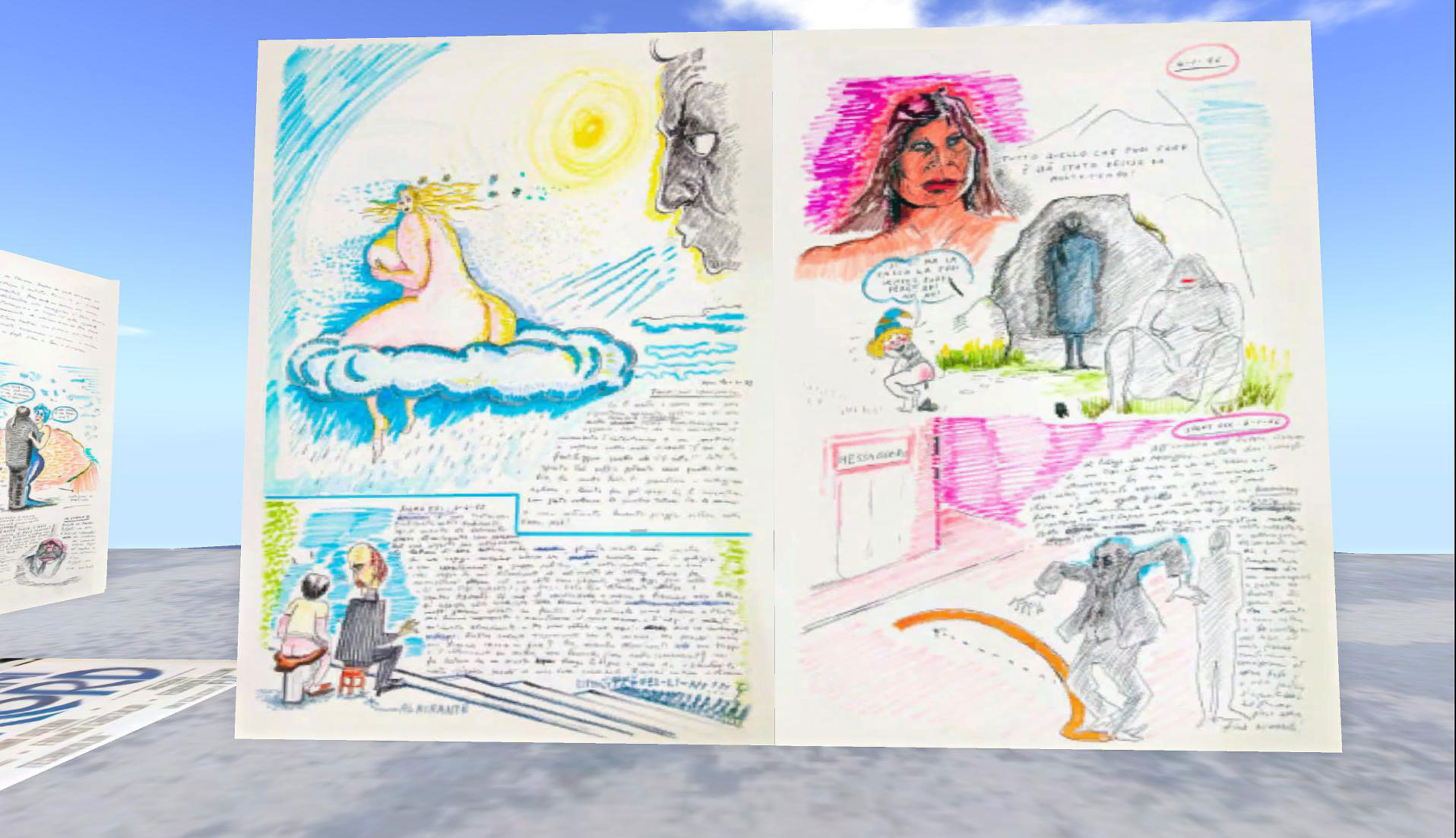
In the 1960s Federico Fellini decided to start a dream diary and ended up keeping this diary for 22 years. Fellini’s ‘Book of Dreams’ (packed with notes and sketches) was published in 2008, about 15 years after his death. Today, a brand new hard back copy can be purchased from Amazon for $775 (there were 4 new copies left when I visited) and apparently Amazon used book sellers have copies available ranging in price from $176.28 to $1,221,71. Oh, and the book weighs 8.2lbs and measures 2.4 x 10.2 x 13.5 inches, really rather a tricky book to read on the morning commute. Now, the reason for telling you all this is because Fellini’s dreams will soon become highly portable as the tome is to be published as an ebook. To celebrate this new digital publication an exhibit devoted to the ‘Book of Dreams’ has been built in Second Life and you can take your avatar for a spin through Fellini’s dream world.
Second Life is the perfect place to promote the ebook edition of Fellini’s dream journal. This world of shared imagination inevitably conjures up strange random juxtapositions. For virtual tourists like myself this chance aspect is a major attraction. At times a teleport to a new location can have the quality of a game of dice with Salvador Dali the evangelist of surrealism. On other occasions we might encounter the gentler dreamy surrealism of a Federico Fellini film. What is more, this surrealistic dream state can often be encountered in the most most mundane areas of the virtual world. For instance, a friend has a house in Second Life suburbia and her neighbor has completely enclosed his virtual home with a giant wooden box. It is just there, no explanation just an object awaiting interpretation. I wonder what Fellini would have done with a virtual world at his finger tips?
Please visit Imparafacile Island to see the extensive exhibition of note books and old movie posters.
I flew over to visit Hypatia in Second Life this evening and am dismayed to find this beautiful, atmospheric location seems to have vanished. I am rather vainly hoping the creators have decided to build elsewhere or start a new project perhaps?
Glimpses of Hypatia Harbor through trees
Roof top view Tusken, Hypatia
Ships and tall tower, Hypatia Harbor
Honor McMillan posted a lovely article about the area in the summer of 2012 titled “Distracted by Hypatia”. Sad to say, it also appears that the neighboring fabulous “Joy of Steampunk Museum” has gone off to another realm as well. Here’s hoping I am completely wrong and my Second Life viewer was just malfunctioning this evening…
UPDATE
Shortly after sending out this post I received the following somewhat reassuring tweet from Corcosman:
“re: Joy of Steampunk. Went there on PhotoHunt event recently. Was told the sim owner was going to build something new.”
So, the sun may indeed have set over Hypatia and the Joy of Steampunk Museum but the good news is that something new is brewing (and my viewer was not on the blink).
And a note about the update Corcosman mentions the Photo Hunt Group in Second Life. This group travels off together to visit a selected location where they all take a number of photographs for one hour. Upon their return the photographers select their favorite image for display. A voting process follows to select the best images from the Photo Hunt. Gridjumper’s Blog explains the procedure in more detail in her post: Take a Photo, Capture an Idea in the Virtual World.
“Imagination will often carry us to worlds that never were. But without it we would go nowhere.” – Carl Sagan
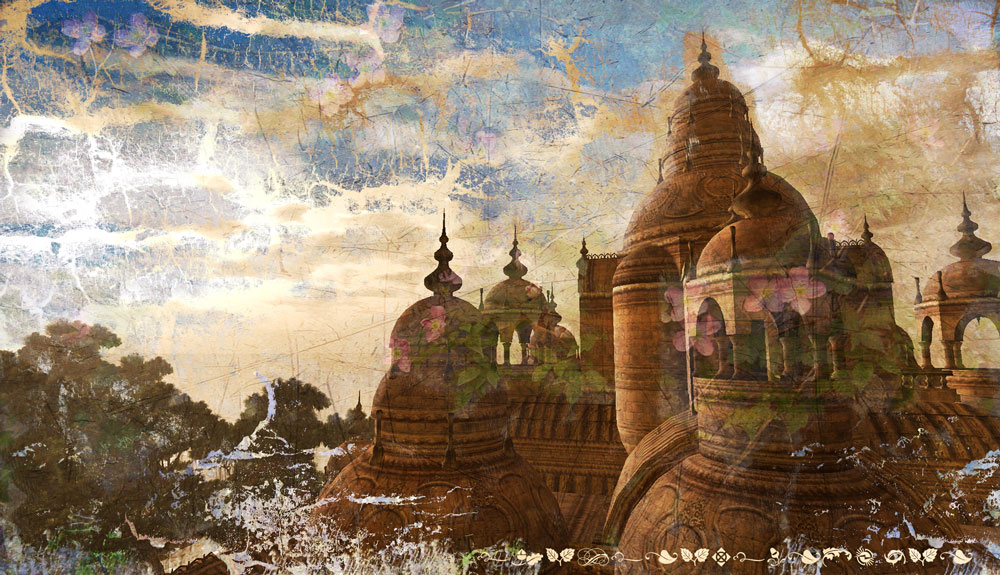
I recently acquired Photoshop CS6 and I have been having a wonderful time experimenting with layers. Layers are a really clever tool that allow you to stack images on top of each other. You can alter the degree of transparency of each image and at the same time erase areas of one picture to allow another to show through. There is a random aspect to this layering and blending that creates a game of visual serendipity. I have taken the opportunity to play with layers of ‘reality’ by combining the imaginary spaces of virtual worlds like Second Life with my tangible world or ‘first life’.
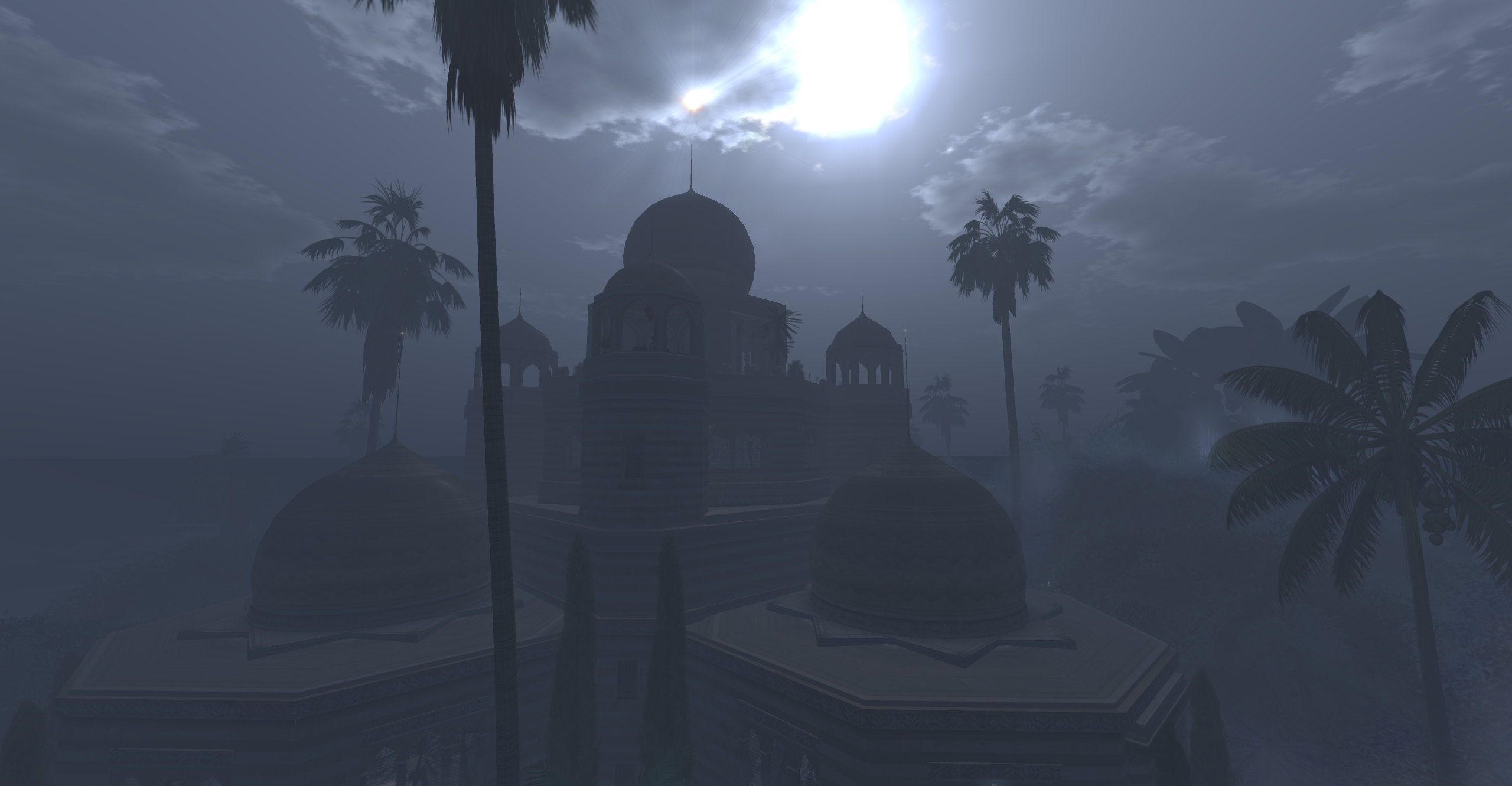
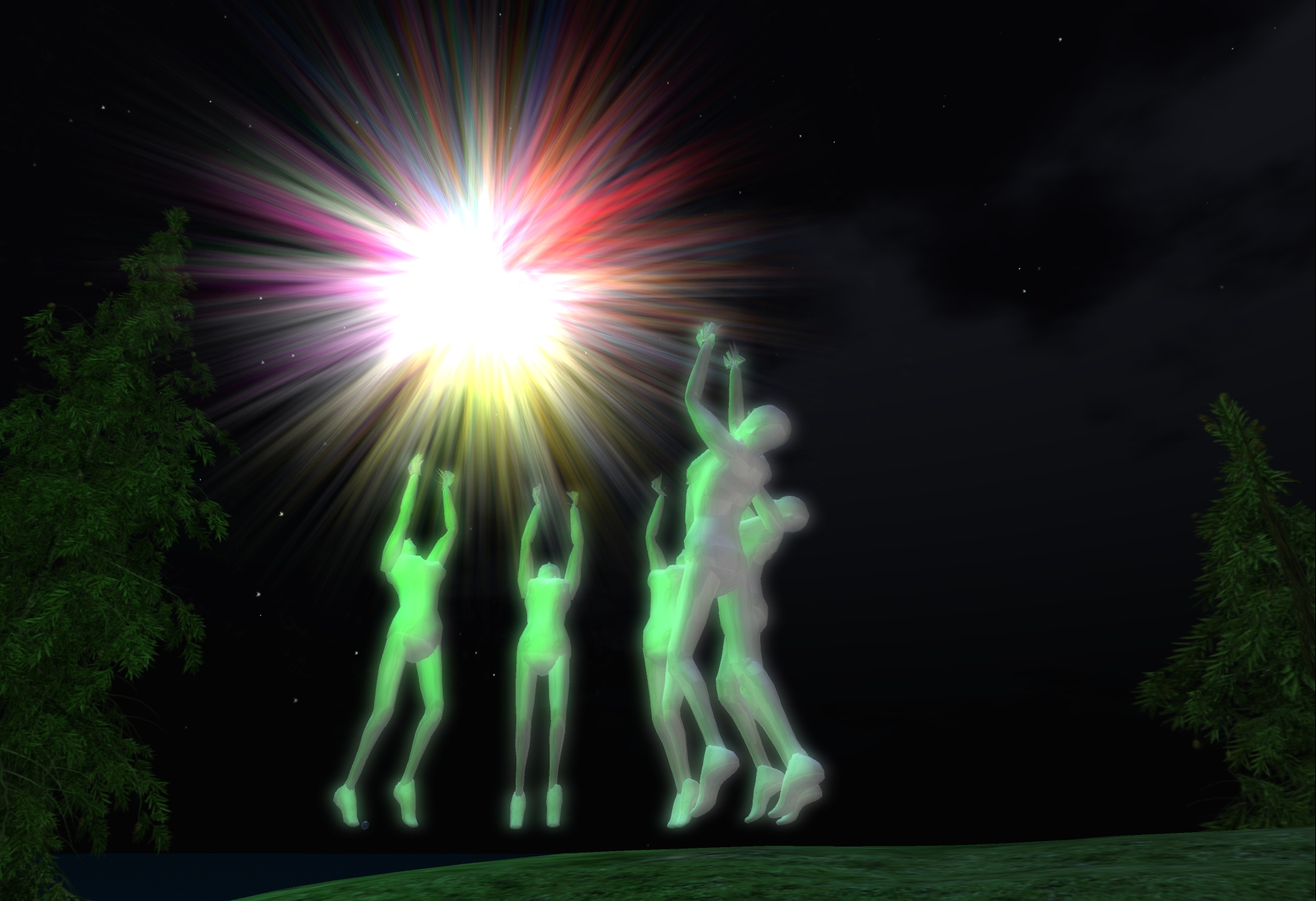
The two photographs in this post show the beautiful temple built by Marcus Inkpen. Sadly, this temple has long since vanished into the ether (see earlier post “The Returning has Departed” for more information). It is intriguing to capture an image of something that existed virtually and now exists no more; it is like dropping into a dream with a camera, the layering of pictures allows memory and imagination to blend and create yet another world that never was…









 Meta Looming